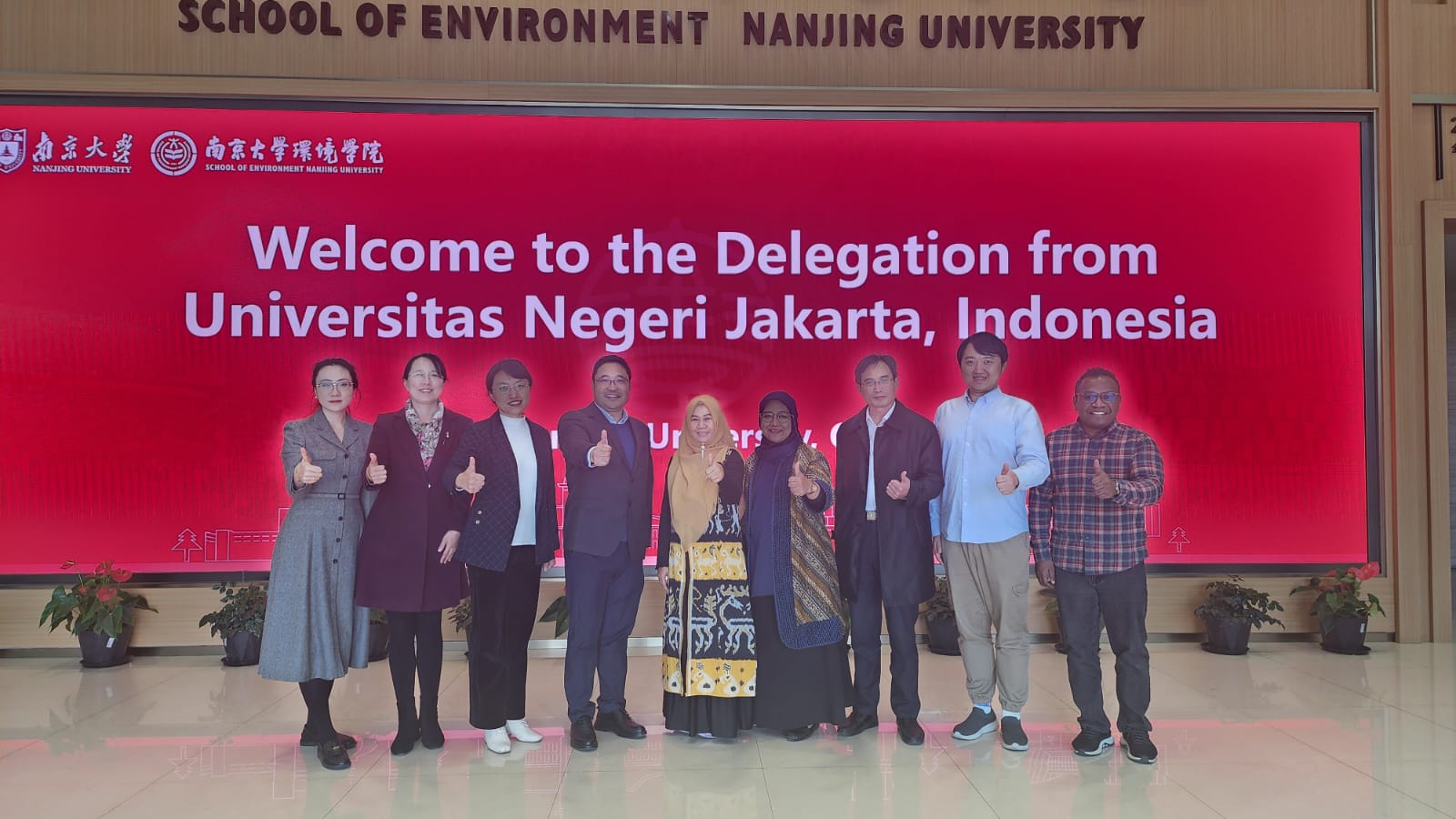
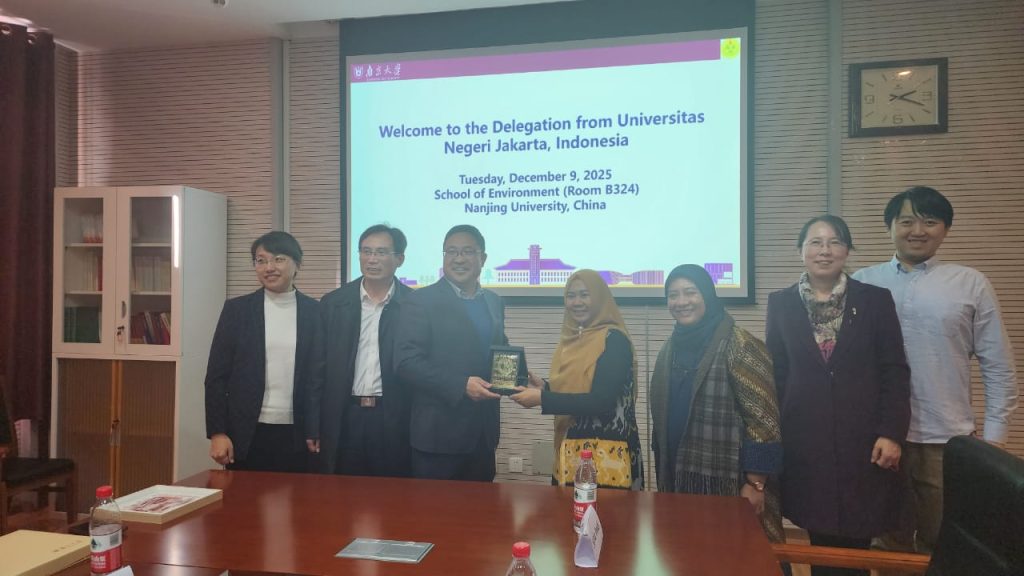
Nanjing, Humas UNJ – Building on a day of significant international partnership, the Universitas Negeri Jakarta (UNJ) delegation of Mutia Delina (Manager of International Cooperation Affairs) and Sri Rahayu (Secretary of International Office) held a pivotal meeting with the prestigious School of Environment at Nanjing University on December 9, 2025. The discussion centered on the establishment of an innovative dual-degree master program explicitly designed to advance the United Nations Sustainable Development Goals (SDGs).
The proposed program will have a sharp focus on a cluster of interconnected environmental and sustainability goals: SDG 6 (Clean Water and Sanitation), 11 (Sustainable Cities and Communities), 12 (Responsible Consumption and Production), 13 (Climate Action), 14 (Life Below Water), 15 (Life on Land), and 17 (Partnerships for the Goals).
This ambitious collaboration aims to create a new generation of environmental scientists, policymakers, and leaders equipped with transdisciplinary knowledge and practical skills to address Asia-Pacific and global sustainability challenges.
Key Highlights of the Proposed Collaboration:
1. Dual-Degree Framework: The core outcome is the development of a master’s level dual-degree program. Students enrolled in the program would spend significant time at both institutions, culminating in degrees awarded by both UNJ and Nanjing University, a top-tier Chinese university renowned for its environmental research.
2. SDG-Centered Curriculum: The curriculum will be uniquely structured around the targeted SDGs, integrating courses in environmental science, urban sustainability, climate change mitigation, circular economy, marine and terrestrial conservation, and international environmental governance.
3. Research-Driven Partnership: The program will be deeply embedded in the research ecosystems of both universities. Students will have access to field sites, advanced laboratories, and joint faculty supervision, working on real-world projects aligned with the SDGs in both Indonesian and Chinese contexts.
4. Strengthening SDG 17: The partnership itself is a direct embodiment of SDG 17 (Partnerships for the Goals), demonstrating how international academic cooperation can be a powerful vehicle for achieving the 2030 Agenda for Sustainable Development.
Sri Rahayu of UNJ emphasized the program’s strategic importance: “This is not merely an academic agreement; it is a commitment to our planet’s future. Partnering with a world-class institution like Nanjing University’s School of Environment allows us to pool expertise and resources to tackle the most pressing environmental issues defined by the SDGs. This dual-degree program will produce graduates who are not just experts, but also cross-cultural collaborators.”
Mutia Delina detailed the vision: “Our discussion moved beyond theory to actionable design. We envisage a program where students analyze water sustainability in Jakarta and Nanjing, study urban resilience models, and work on joint conservation projects. This hands-on, comparative approach is essential for effective problem-solving.”
Professors from the School of Environment, Nanjing University,Hongyan Guo, Wenlei Zhu, Gu Cheng and Mei Li welcomed the initiative: “We are impressed by UNJ’s commitment to the SDGs and see immense synergy in this partnership. Combining our research strengths on regional environmental challenges with UNJ’s grounded perspective will create a powerful educational model with tangible impact.”
Following this foundational meeting, academic committees from both institutions will begin the detailed work of curriculum harmonization, credit system alignment, and formal agreement drafting. The target is to finalize the dual-degree agreement and open applications for the inaugural student cohort for the 2027 academic year.